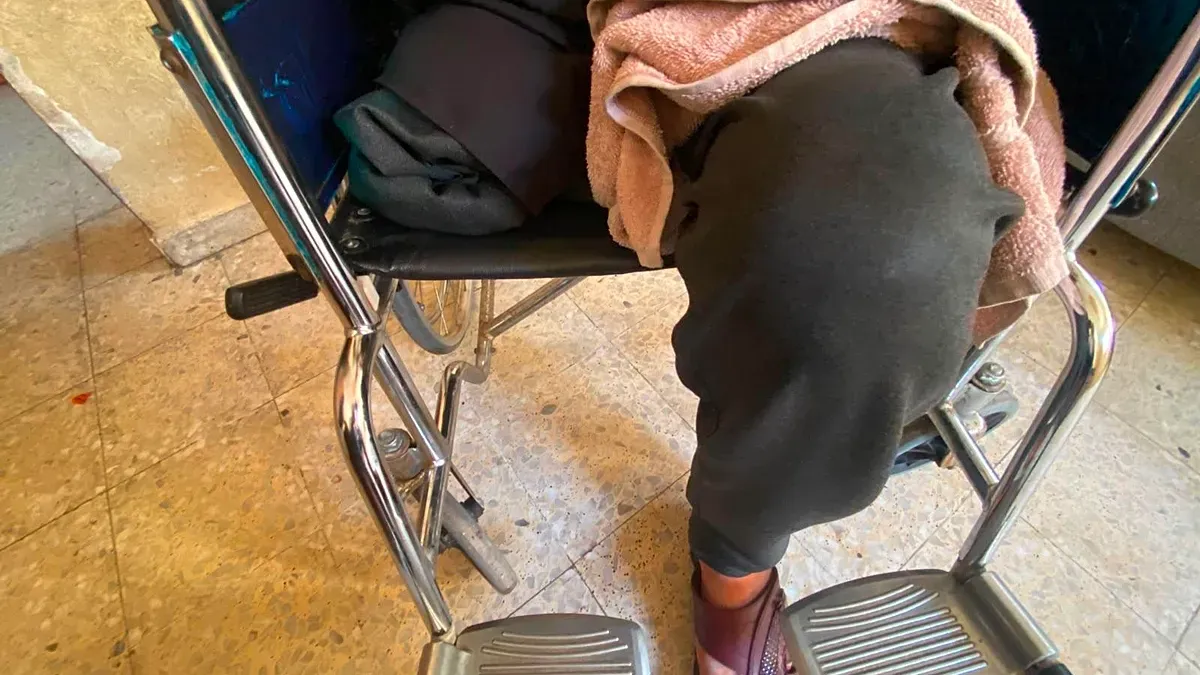
"I thought only hours separated me from my children, but suddenly I was told my name was not allowed to return." With these words, M.M., a 34-year-old Palestinian mother from the Gaza Strip, summarizes a tragedy that has lasted nearly two full years.
M.M. left Gaza for treatment months after the outbreak of the genocidal war, leaving behind her husband and most of her children. She never imagined that the treatment trip would turn into a forced exile with no horizon. When she finally registered her name for return via Egypt, she thought her suffering was nearing its end. But the Israeli rejection came suddenly and without explanation, leaving her in a state of shock. As she described it, "My heart is broken because my children have been waiting for me for nearly two years."
M.M.'s story is not an exception, but one of dozens of testimonies documented by the Gaza Center for Human Rights in recent weeks, revealing a recurring and escalating pattern: preventing Palestinian citizens, including women, children, patients, and the elderly, from returning to the Gaza Strip through what is known as "security rejection" issued by the Israeli occupation authorities, without justification and without any effective legal mechanism for appeal.
According to the rights center, Palestinians wishing to return to Gaza are forced first to register their names with the Palestinian Embassy in Cairo or through a private coordination company. These names are then submitted to the occupation authorities for review and approval, in a process that may take days or weeks of pending waiting.
What is more dangerous than the length of the procedures, according to the documented testimonies, is that the rejection decisions come repeatedly and suddenly, affecting categories not usually classified as security concerns, such as women, the elderly, and children, without providing any justification. This turns the right to return home, in the center's description, into a "privilege subject to the unilateral will of the occupation authorities."
Ms. Aisha, 42, lives a similar chapter of this tragedy. For months, she has been away from her husband and children. Despite being aware of the ongoing danger in Gaza and the unceasing death and hunger there, she chose to return to reunite her family, which lost several members during the war. But she, too, was surprised by the rejection of her name. She says with regret: "Why does my return to my destroyed home require approval from the occupation? I feel our lives are suspended by a decision whose reasons we don't know and when it might change."
As for the elderly Abdul Aziz, 68, he left Gaza hoping only for treatment, thinking his absence would not be long. But he also faced rejection of his return request. He says: "What pains me most is my loneliness in exile and my worry for my children and grandchildren. I want to return so we can be together in our homeland, no matter what."
The crisis, according to the center, does not end with rejection. Even those allowed to return find themselves facing a long series of complex and humiliating security procedures at the crossing, including prolonged and degrading inspections, repeated interrogations, and confiscation of personal belongings.
The center documented cases of arrest of returnees who held prior approvals, in addition to some, including women, being subjected to beatings, ill-treatment, threats, and extortion during crossing procedures.
The Gaza Center for Human Rights believes that the accumulation of these practices goes beyond any declared security considerations, revealing a systematic Israeli policy aimed at creating a push environment for Palestinians, weakening family and social ties, and subjecting the right of return to arbitrary restrictions, in line with broader efforts to reshape the demographic reality in the Gaza Strip and impose forced displacement as a fait accompli.
According to the center, these practices constitute a grave violation of the rules of international humanitarian law and international human rights law. Article 12/4 of the International Covenant on Civil and Political Rights explicitly prohibits arbitrarily depriving anyone of the right to enter their own country. Article 17 of the same Covenant protects family life from arbitrary interference, and Article 23 guarantees protection of the family as the natural and fundamental unit of society.
The Fourth Geneva Convention of 1949 also prohibits any measures that harm protected persons, separate families, or lead to their transfer or forced displacement. The Rome Statute of the International Criminal Court stipulates that deportation or forcible transfer of population, when committed as part of a widespread or systematic attack against civilians, may amount to a crime against humanity, in addition to being a grave breach of international humanitarian law when it affects protected persons in occupied territory.
In light of this, the Gaza Center for Human Rights called on the United Nations, the International Committee of the Red Cross, relevant special rapporteurs on human rights, and the international community at large to take urgent action to ensure the return of all Palestinians stranded outside the Gaza Strip without restriction or condition, put an end to the policy of arbitrary prevention, secure humane crossing mechanisms that respect human dignity, and hold accountable those responsible for violations committed against travelers.
The center concluded its statement by emphasizing that the right to return to one's homeland, freedom of movement, and family unity are non-negotiable rights that cannot be suspended by the will of the occupation authority, and that any policy aimed at keeping Palestinians forcibly outside their places of residence is part of a broader system aimed at imposing forced displacement and changing the demographic composition of the occupied Palestinian territories, requiring urgent international action to stop these violations and ensure accountability and an end to impunity.
A media outlet specialized in the Palestinian cause in its human rights, humanitarian, political, and civilizational dimensions, founded in 1997, and was a pioneer in covering Palestinian news, with the slogan: The voice of Palestine to the world, and the voice of the world to Palestine.
All rights reserved – Palestinian Information Center – © 2026